
EC Policy Changes 2026: 10-Year MOP, 90% Quota & DPS Scrapped
Major EC Policy Shakes Singapore Property Market
MOP Doubled to 10 Years, First-Timer Quota Raised to 90%, and Deferred Payment Scheme Scrapped — What Buyers Must Know Now
10 Years
New Minimum Occupation Period
90%
First-Timer Quota
15 Years
Full Privatisation Timeline
S$1,843
Median PSF (Jan–Apr 2026)
Key Takeaways at a Glance
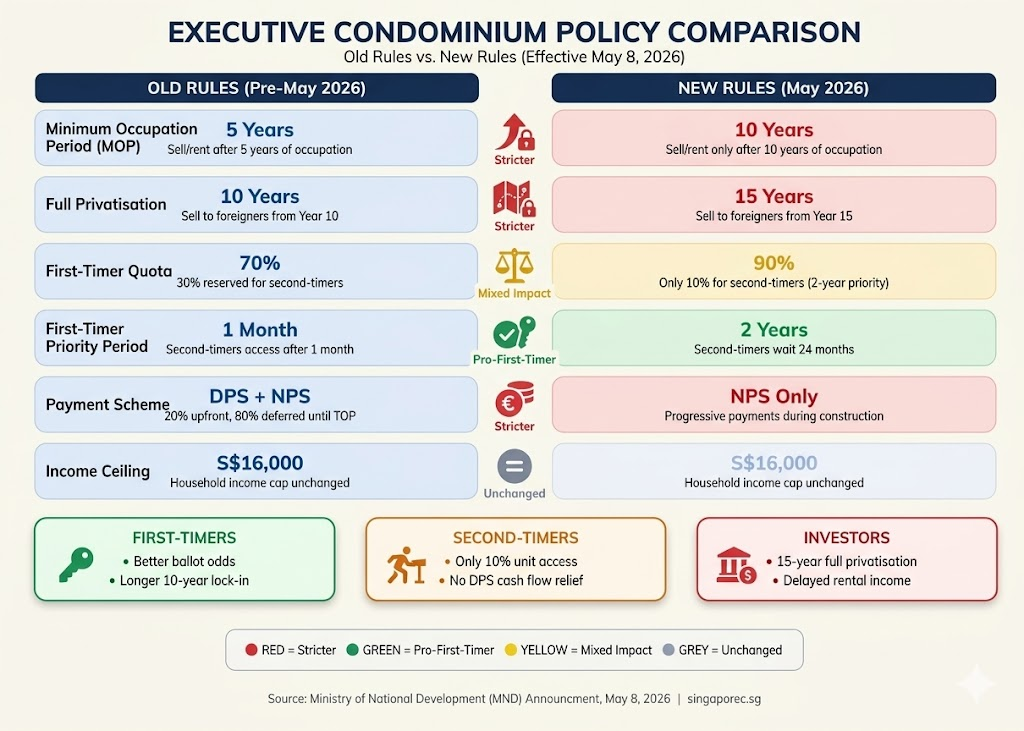
- MOP doubled from 5 to 10 years — EC owners must occupy for a full decade before selling, renting whole unit, or buying another property
- Full privatisation extended to 15 years — Foreign buyers can only purchase after 15 years from TOP
- First-timer quota jumps to 90% — Reserved for 2 years (up from 1 month), dramatically improving odds for new families
- DPS completely scrapped — All buyers must use Normal Payment Scheme with progressive payments
- Immediate effect — Applies to all EC GLS sites with tender closing on or after May 8, 2026
In a landmark move announced on May 8, 2026, Singapore's Ministry of National Development (MND) unveiled sweeping changes to the Executive Condominium (EC) scheme that will fundamentally reshape how Singaporeans buy, sell, and invest in these hybrid public-private homes. National Development Minister Chee Hong Tat announced three major policy shifts at the National University of Singapore IREUS Urban Housing Symposium.
These changes apply immediately to all EC Government Land Sale (GLS) sites with tender closing dates on or after May 8, 2026, and signal a decisive government intervention to cool a red-hot EC market where median prices per square foot (PSF) have more than doubled from S$782 in 2016 to S$1,843 in the first four months of 2026.
The Three Game-Changing EC Measures Explained
1. Minimum Occupation Period Doubled to 10 Years
Buyers must physically occupy their unit for a full decade before selling on the open market, renting the entire unit, or purchasing another residential property. Full privatisation extended from 10 to 15 years.
2. First-Timer Quota Raised to 90%
The quota reserved for first-timer families jumps from 70% to 90% of all EC units. The priority period extends from one month to two full years from the project's launch date.
3. Deferred Payment Scheme Scrapped
Developers can no longer offer DPS. All EC buyers must use the Normal Payment Scheme (NPS), making progressive payments based on construction milestones.
MOP 10 Years: The End of Quick Flips
Under the new rules, buyers of new ECs must physically occupy their unit for a full decade before they can sell on the open market to Singapore Citizens and Permanent Residents, rent out the entire unit, or purchase another residential property.
Additionally, full privatisation — the point where ECs can be sold to foreigners and corporate entities — has been extended from 10 years to 15 years. This means EC owners must wait 15 years from TOP (Temporary Occupation Permit) before unlocking the widest possible buyer pool.
This extension directly targets speculative behaviour. Minister Chee noted that between 2021 and 2025, approximately 75% of ECs were sold within five years after their MOP — up sharply from 45% in the preceding five-year period. Many sellers pocketed substantial gains, with 38 EC transactions recording over S$1 million in gross profit in 2024 alone.
90% First-Timer Quota: Levelling the Playing Field
The government is dramatically tilting the playing field toward first-time buyers. The quota reserved for first-timer families jumps from 70% to 90% of all EC units. Even more significantly, the priority period has been extended from just one month to two full years from the project's launch date.
This means developers must hold 90% of units exclusively for first-timers for 24 months before they can release remaining inventory to second-time buyers. Previously, after just one month, unsold units were opened to all eligible buyers — and second-timers with larger housing budgets from selling their previous homes often snapped them up quickly.
The data tells the story: in 2020, about half of EC buyers were first-timers. By 2024 and 2025, that proportion had dropped to just 30–40%. Second-timers, armed with sale proceeds from their first properties, have increasingly dominated the EC market, pricing out young married couples and families the scheme was originally designed to help.
DPS Scrapped: Financial Prudence Enforced
Developers can no longer offer the Deferred Payment Scheme for uncompleted ECs. Under DPS, buyers paid just 20% upfront and deferred the remaining 80% until the project obtained its TOP — typically 2-3 years after launch. Buyers using DPS generally paid a 2-3% premium over the normal purchase price.
Now, all EC buyers must use the Normal Payment Scheme (NPS), making progressive payments based on construction milestones. This change encourages financial prudence and aligns EC payment arrangements with other uncompleted private residential properties.
Why Now? The EC Market Has Been Running Too Hot
The policy intervention follows months of escalating concern about EC affordability. During the March 2026 parliamentary debate on his ministry's budget, Minister Chee announced the EC policy would be reviewed following concerns that prices had "skyrocketed."
The numbers are stark. EC prices have surged alongside land bids. The latest EC launch, Rivelle Tampines , sold over 92% of its 572 units on launch day at an average price of S$1,893 PSF — with 3-bedroom units starting near S$1.6 million and 5-bedrooms exceeding S$2.5 million. Just weeks earlier in January, Coastal Cabana in Pasir Ris sold 67% of units at S$1,734 PSF average.
Land prices have climbed to fresh highs too. Bidders for two Woodlands plots pushed EC land prices to S$782 PSF per plot ratio (PPR) in August 2025, then S$794 PSF PPR in January 2026. With land costs rising and strong demand at every launch, developers had little incentive to moderate pricing.
The government hopes these measures will "result in developers reducing their land bids and the prices for their ECs," as Chee stated. With developers now able to sell only 10% of units to second-timers during the first 39 months, bidding behaviour is expected to turn more conservative.
What This Means for Different Buyer Groups
● First-Timer Buyers: Better Odds, But Patience Required
Young couples and families looking for their first home stand to benefit the most. With 90% of units reserved exclusively for them over two years, the competitive pressure from cashed-up second-timers is significantly reduced.
- Apply early within the 2-year priority window — your odds are now significantly better
- Budget for NPS cash flow from day one; there is no DPS safety net
- Be prepared for a 10-year commitment; ensure your career and family plans align
- Act quickly on current launches if the old rules (5-year MOP, DPS available) still appeal — but verify the site's tender closing date
However: The 10-year MOP means you must commit to living in your EC for a full decade before unlocking any liquidity. If career changes, family expansion, or relocation force a move, you cannot rent out the entire unit or sell until Year 10. Room rentals remain permitted subject to HDB rules, but whole-unit rental is off the table for a decade.
● Second-Timer Buyers: Significantly Narrower Window
Second-timers face the sharpest constraints. With only 10% of units available in the first two years and no DPS to ease cash flow, upgrading from an HDB flat to an EC becomes substantially harder.
- Consider private condos or resale ECs already past MOP as alternatives
- Evaluate your financial runway carefully — without DPS, you need to manage HDB sale proceeds across a longer transition period
- Wait until after the 2-year priority window to access the 10% second-timer pool, but be prepared for limited inventory
The removal of DPS is particularly painful for second-timers who were relying on the deferred structure to manage the transition between selling their HDB and moving into their EC. With NPS mandatory, the financial overlap period becomes more demanding.
● Investors: The Speculation Playbook Is Rewritten
The classic EC investment strategy — buy at launch, endure 5-year MOP, sell immediately upon privatisation to capture appreciation — no longer works. The 10-year MOP and 15-year full privatisation timeline mean investors must hold for twice as long before realising gains.
- Recalculate your return timeline — 10-year MOP + 15-year privatisation shifts the investment horizon significantly
- Consider whether private condos offer better liquidity and rental flexibility for your portfolio
- Resale ECs (already past MOP) may offer immediate rental income without the new restrictions
That said, ECs still offer a 20-30% price discount versus comparable private condos at launch, and the eventual 15-year full privatisation still opens the door to foreign buyers. For patient, long-term investors, the fundamentals remain sound — but the holding period is now far longer.
Impact on Developers and Future Supply
Developers bidding on upcoming EC sites — including a Canberra Drive site (May 2026 tender) and a Sembawang Drive site (June 2026) — will likely adopt more conservative land bids. The combination of 90% first-timer quota, extended priority period, and mandatory NPS reduces pricing power and sales velocity.
First-timers generally have tighter budgets than second-timers. If developers cannot command the same premiums from upgraders with HDB sale proceeds, launch prices may moderate. As Minister Chee explicitly stated: "We hope this will result in developers reducing their land bids and the prices for their ECs."
Industry watchers expect launch sales to slow. Inventory unsold by the end of the first-timer priority period was previously snapped up quickly by second-timers. With that release now delayed to two years, developers may face longer carrying costs and adjusted sales strategies.
EC vs Private Condo: The Calculus Has Changed
The gap between ECs and private condominiums has narrowed in recent years, both in price and policy terms. Here's how the comparison looks under the new regime:
| Factor | EC (New Rules) | Private Condo |
|---|---|---|
| Entry Price | 20-30% lower | Market rate |
| CPF Grant | Up to S$30,000 | None |
| MOP / Rental | 10 years before whole-unit rental | Immediate |
| Full Privatisation | 15 years (sell to foreigners) | Immediate |
| Payment Scheme | Normal Payment Scheme only | Normal Payment Scheme |
| Income Ceiling | S$16,000 household | No ceiling |
| Financing | Bank loan (25% down) | Bank loan (25% down) |
The EC value proposition still rests on three pillars: lower entry price(20-30% below private condos), CPF Housing Grants up to S$30,000 for eligible first-timers, and the long-term upside of full privatisation at Year 15. But the cost of those benefits — a decade of physical occupation and no DPS — has risen substantially.
What Should Buyers Do Now?
If You Are a First-Timer
- Apply early within the 2-year priority window — your odds are now significantly better
- Budget for NPS cash flow from day one; there is no DPS safety net
- Be prepared for a 10-year commitment; ensure your career and family plans align
- Act quickly on current launches if the old rules (5-year MOP, DPS available) still appeal — but verify the site's tender closing date
If You Are a Second-Timer
- Consider private condos or resale ECs already past MOP as alternatives
- Evaluate your financial runway carefully — without DPS, you need to manage HDB sale proceeds across a longer transition period
- Wait until after the 2-year priority window to access the 10% second-timer pool, but be prepared for limited inventory
If You Are an Investor
- Recalculate your return timeline — 10-year MOP + 15-year privatisation shifts the investment horizon significantly
- Consider whether private condos offer better liquidity and rental flexibility for your portfolio
- Resale ECs (already past MOP) may offer immediate rental income without the new restrictions
Unsure Which Path Fits Your Situation?
Every buyer's financial profile and family timeline is different. Get a personalised EC strategy session with our property specialists — no obligation, just clarity.
Get Your Free ConsultationMarket Outlook: What Experts Are Saying
"By curbing second-timers, first-time buyers will have a better chance of successfully applying for ECs that fall within their financial means. The new rules will help stabilise the EC markets over the next three to five years, and we are unlikely to see a sharp rise in EC prices if economic and income growth remain stable."
The government is simultaneously ramping up supply. Minister Chee indicated in January 2026 that approximately 12,000 units of private housing, including en-bloc redevelopment sites and ECs, are expected to launch this year. More supply, combined with tempered demand from the new rules, should contribute to price stabilisation.
Conclusion: A New Era for Executive Condominiums
The May 2026 EC policy overhaul marks a fundamental reset of Singapore's executive condominium market. By doubling the MOP, extending full privatisation to 15 years, reserving 90% of units for first-timers over two years, and eliminating the DPS, the government has sent an unambiguous signal: ECs are for home ownership, not speculation.
For first-time buyers, the door is now wider open — but with a longer commitment attached. For second-timers and investors, the path is narrower and requires greater patience. For developers, land bids and pricing strategies must recalibrate to a market where affordability, not speculative upside, is the governing principle.
Whether you are a young couple dreaming of your first condo-style home, an upgrader planning your next move, or an investor weighing Singapore property opportunities, understanding these new rules is essential. The EC market is entering a new era — and the buyers who adapt their strategies first will be best positioned to thrive in it.
Frequently Asked Questions
What is the new MOP for ECs in 2026?
The Minimum Occupation Period (MOP) for new Executive Condominiums has been doubled from 5 years to 10 years for all EC Government Land Sale sites with tender closing dates on or after May 8, 2026. Full privatisation has also been extended from 10 years to 15 years.
Can second-timers still buy ECs under the new 2026 rules?
Yes, but with significant constraints. Only 10% of EC units are available to second-timers during the first two years from launch. After the 2-year priority period, remaining units are released to second-timers. The removal of DPS also makes upgrading financially more challenging.
Is the Deferred Payment Scheme (DPS) still available for ECs?
No. The Deferred Payment Scheme has been completely scrapped for all new ECs. All buyers must now use the Normal Payment Scheme (NPS), making progressive payments based on construction milestones.
How does the 90% first-timer quota affect EC balloting?
With 90% of units reserved for first-timers over a 2-year priority period (extended from 1 month), first-time buyers have significantly better odds of securing a unit. Second-timers face a much narrower 10% window and must wait 24 months before accessing unsold inventory.
Should I buy an EC or private condo in 2026?
ECs still offer 20-30% lower entry prices and CPF Housing Grants up to S$30,000, but now require a 10-year MOP and 15-year wait for full privatisation. Private condos offer immediate rental income and liquidity but at higher prices. The choice depends on your holding period, cash flow needs, and eligibility.
Which upcoming EC launches are affected by the new rules?
All EC GLS sites with tender closing dates on or after May 8, 2026 fall under the new rules. This includes the Canberra Drive site (May 2026 tender) and Sembawang Drive site (June 2026). Projects that launched before this date, such as Rivelle Tampines and Coastal Cabana , operate under the previous 5-year MOP framework.
Related EC Market Analysis
Get Personalised EC Advice
Every buyer's situation is unique under these new rules. Speak with our EC specialists to map out your best strategy.
